
You’ve probably heard the phrase “garbage in, garbage out” when it comes to computers, right? Well, when it comes to AI tools like ChatGPT or Claude, that saying couldn’t be truer.
The magic of AI isn’t just in the model but it’s in how you ask it for what you want and this is where prompt engineering comes in.
Now, I know what you’re thinking: “Do I need to be some kind of AI wizard or have studied some kind of course to engineer prompts?” Absolutely not.
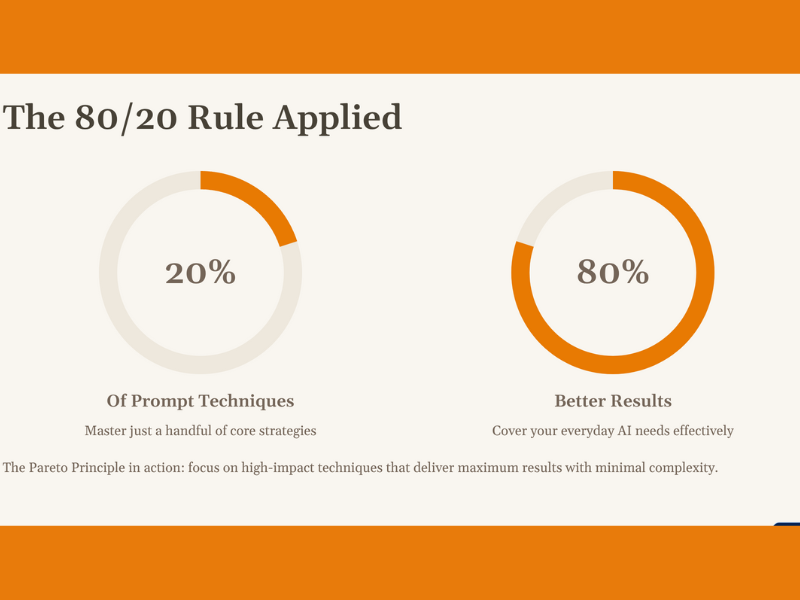
In fact, most people waste time overcomplicating prompting when the truth is simple: the 80/20 rule applies. That means 20% of the prompt techniques you use will produce 80% of the results you want, and this method is called the Pareto principle in action in prompt engineering.
Let’s simplify the process. In this article, I will show you a handful of techniques that actually matter in prompt engineering, so instead of struggling with messy outputs, you will start getting consistent, high-quality results whether you’re a student, entrepreneur, writer, or just curious about AI.
What is Prompt Engineering?
Prompt engineering is essentially the art of instructing AI clearly enough to produce the exact output you need. For a clearer breakdown, you can also read What is Prompt Engineering? The Simple Skill That Makes AI Work Way Better. Think of it like ordering food at a restaurant:
If you tell a waiter, “Please, give me food,” the waiter will serve you a random plate of any type of food from the menu, it could even be what you do not like but if you tell the waiter, “I’d love to order Chinese rice with grilled chicken and salad on the side,” then the waiter knows exactly what to serve you.
The same goes for AI, how you write a prompt to AI is your order, and the clearer, smarter, and more intentional you are, the better your AI performs and gives good results.
What is the 80/20 Rule in Prompt Engineering?
As stated earlier, the 80/20 rule in prompt engineering, also known as the Pareto Principle, states that 20% of the efforts you apply to prompting yield 80% of the results.
When dealing with AI, this means you don’t need to learn 50 different prompting hacks; instead, a handful of practical prompts can cover 80% of your everyday needs, including writing, brainstorming, research, planning, learning, and content creation.
Strategies for 80% Better Results in Prompt Engineering
1. Be explicit and clear
When you are explicit and clear, it reduces guesswork because AI knows exactly what format, tone, and length to deliver. So, instead of asking AI to “Generate a post”, you can say, “Write a 100-word Instagram caption promoting a summer sale on handmade jewelry, using a friendly tone and including hashtags.”
2. Use few-shot prompts and show the AI examples.
When you provide 2-3 model outputs as templates, it teaches AI the style, structure, and desired detail level to follow. For instance,
Example 1: A 3-sentence product description for running shoes aimed at casual joggers. Example 2: A 3-sentence product description for running shoes aimed at competitive athletes. Now generate one for hiking boots aimed at weekend explorers.
3. Define the role
If you want AI to act as an expert, then define the role you want it to act as:
“You’re a financial advisor writing for young professionals. Provide investment tips in bullet form, suitable for beginners.”
4. Ask for refinements.
Use follow-ups like:
- “Make this friendlier.”
- “Shorten to 50 words.”
- “Add 3 popular hashtags.”
This way you are refining the outputs faster than redoing them from scratch.
The 5 Core Types of Prompting
Here are the main prompting techniques you can actually use for your day-to-day tasks for prompt engineering.
1. Tree-of-Thoughts (ToT)
ToT explores branches, evaluates them, and backtracks them. You can use it for naming, campaign concepts, content outlines, roadmaps and just anything creative where you want breadth before depth.
Research shows that the Tree-of-Thoughts prompting explores multiple ideas, scores them, and then refines them. Additionally, it is ideal for creative work, such as naming or campaign ideas.
Prompt example
Create 3 distinct concepts (A/B/C).
Score each for originality, feasibility, and audience fit (1–5).
Pick a winner and refine once.
2. Role-Based Prompting
Tell AI the role you want it to act as, like “You are a senior brand strategist”, then add crisp constraints (length caps, banned phrases, structure). This is the default for campaigns, scripts, and blog posts that must sound consistent.
By doing it this way, it adapts tone, expertise and style and also sets a clear voice.
Prompt example
- Basic: “Write Instagram captions.”
- Better: “You are a witty social media manager for a coffee brand. Write 5 captions that are playful, Gen Z-friendly, and include a CTA to visit our café.”
3. Few-Shot Prompting
This is a kind of prompting where you show AI one or two examples before asking for more and then it’ll just copy the pattern. For instance;
Prompt example
Example 1: A 3-sentence product description for running shoes aimed at casual joggers.
Example 2: A 3-sentence product description for running shoes aimed at competitive athletes.
Now write one for hiking boots aimed at weekend explorers.
4. Chain-of-Thought Prompting (Cot)
This prompting has to do with asking AI to think step by step. It is great for reasoning, analysis, problem-solving, or planning.
This way you can have it sample multiple short reasoning paths and choose the majority answer.
Prompt example
Think step by step and then generate 5 candidate answers briefly. Once done, pick the final answer that most candidates agree on.
5. JSON Prompting (Structured Output)
If you want consistency, structure, or automation, use JSON. Models love it because it’s machine-readable.
Example
task”: “generate_instagram_caption”,
“product”: “handmade summer bracelet”,
“tone”: “friendly”,
“hashtags”: [“#summerstyle”, “#handmadejewelry”, “#bohochic”],
“length”: 100
This way, your output isn’t just text but it’s data you can plug straight into a CMS, app, or workflow.
What Does JSON Prompting Look Like?
Instead of an unstructured text, JSON prompts clearly define fields and expectations. This guide-like prompt tells the AI exactly what to produce and how to produce it to minimize hallucinations and vague replies.
- JSON instructs AI like a form rather than a guessing game.
- Ideal for building apps and automations that require precise, structured outputs.
- Enhances interoperability: outputs can feed directly into databases or publishing systems.
6. Iterative Prompting
Iterative prompting is a kind of prompting where you do not treat the first output from AI as your final draft. Think of AI as your co-creator, give it feedback, refine, and rerun again.
Example
First: “Write 10 Instagram captions for a skincare brand.”
Then: “Make them shorter, funnier, under 15 words.”
Then again: “Add emojis and trending hashtags.”
7. Least-to-Most prompting
In this prompt, you break a big problem/task into smaller sub-problems and solve it in a sequence especially when the examples are simpler than your real task. This prompt is handy for product requirements, strategies, migration plans, or learning pathways.
Prompt example
- Decompose the problem into simple sub-steps (1–5).
- Solve them in order and ensure that each step may refine the previous.
- Return a concise summary and the final plan.
8. ReAct (Reason + Act) Prompting
- ReAct interleaves thinking with external actions, such as searching, fact-checking, browsing, calling a tool, and then integrating the results. It consistently outperforms “just-think” or “just-act” on complex tasks, and it is excellent for research tasks. If your workflow involves looking things up, like the sources, prices, or references, then ReAct is your grown-up friend.
Prompt example
1) PLAN: what needs to be known.
2) SOURCES: propose 3 credible sources you’d consult.
3) SYNTHESISE: Bullet key facts with inline citations/placeholders.
4) DRAFT: produce output (use the JSON schema).
5) VERIFY: List claims needing fact-checks; set uncertain fields to null.
Practical Prompt Templates (Your 20% in Action)
Here’s how to apply the 80/20 approach in prompt engineering for your different needs:
Writing
- Basic prompt: “Write an article on social media marketing.”
- 80/20 prompt: “You are a social media strategist. Write a 1,000-word engaging blog post on how small businesses can use TikTok to grow sales. Use a conversational tone, add 3 case study examples, and end with practical tips.”
The difference is that you are stating your specific role, including all the details and also a structure.
Learning
- Basic prompt: “Explain quantum physics.”
- 80/20 prompt: “Explain quantum physics to me as if I’m 10 years old, using everyday objects as examples. Keep it fun but accurate.”
Brainstorming
- Basic prompt: “Give me business ideas.”
- 80/20 prompt: “Act as a creative startup coach and suggest 10 business ideas in the food industry that combine health and convenience. Then, list them with potential target audiences and revenue streams.”
Now by doing this you’re not just getting random ideas but you’re getting actionable ones.
Problem-Solving
- Basic prompt: “Help me write a business plan.”
- 80/20 prompt: “I’m starting a kilishi business in Nigeria. Act as a business consultant and draft a simple business plan including market research, pricing strategy, operations plan, and marketing ideas. Keep it under 2,000 words and easy to follow.”
Content Creation
- Basic prompt: “Write Instagram captions.”
- 80/20 prompt: “You are a witty social media manager for a coffee brand. Write 5 Instagram captions that are playful, Gen Z-friendly, and include a CTA to visit our café.”
By using this prompt, the results AI will give to you will be captions that actually sound like your brand and not a robot.
Common Prompting Mistakes in Prompt Engineering
I have seen people sabotage their results without even realizing it. Here are some common prompting mistakes that people make in prompt engineering:
- Being too vague
- Overloading the AI model with a lot of long and confusing instructions.
- Expecting perfection in one shot.
- Not knowing your goal. If you don’t know what you want, then your AI won’t know either.
The truth is that prompt engineering is about being clear and intentional. The people who know how to talk to AI smartly will always stay ahead, and with just a handful of high-impact strategies like clarity, context, role-setting, examples, iteration, and structured outputs, you’ll unlock 80% of AI’s value without drowning in complexity.
So the next time you fire up ChatGPT? Don’t just type “write me an essay.” Instead, use this guide on prompt engineering to shape your request and watch the AI deliver results that actually sound like you.
You can also get our eBook on the Ultimate Workflow System Prompts Guide For Creators and Entrepreneurs to gain access to amazing prompts you can start using today.