
As a creative, I have always been fascinated by AI and more concerned about the results it produces. I always want to see results that can make a real impact for my brand and not just the hype of the AI tool, rankings, or what is trending on social media.
So, I decided to do a small experiment. I tested two very popular AI tools, ChatGPT and Gemini Nano Banana, using identical conditions, prompts, and setups, and then compared the results obtained from each tool.
Initially, I believed it would be a straightforward task with comparable outputs, given the identical prompts, but I was utterly mistaken.
When the results started coming in, I had to double-check my work, but it was still two entirely different results. One of the results had a polished, cinematic energy that felt almost artistic, while the other one looked so clean, crisp, and grounded that it looked like it could be dropped straight into a catalogue.
I won’t lie, I was a bit shocked and confused, so I had to pause and think to myself, ‘Between ChatGPT and Gemini Nano Banana, which of these AI tools do I actually want for my business?’
The Reason Why I Carried Out This Experiment
As a creative, I am aware that every single AI tool I use has an impact on how my brand appears. Your brand’s image is shaped by the content you create, the images you share, and the style and tone of your marketing. All these factors shape our audience’s perception of our brands.
A minor difference in the quality, mood, or realism of the content I produce can determine whether I attract a client’s attention or am ignored; in the world of AI, it’s easy to get caught up in trends when you hear comments like “this model is newer,” “this one is smarter,” or “everyone says it’s better.” But honestly, hype doesn’t pay the bills; eligible and usable results do.
This test was crucial because I wanted to understand the practical performance of each AI tool.
The First Step I took
I set up both ChatGPT and Google’s Gemini Nano Banana on my screen. Everything was controlled, the same environment, the same device, and even the same settings. I didn’t make any adjustments or add extra instructions.
Then came the crucial moment: I assigned them the same prompt and waited.
The Results I got
When the first result appeared, I had a double-take moment. My initial thought was: “Okay… that’s impressive.” Then the second output arrived, and I experienced another moment of realisation: “Wait, that’s entirely different.”
It wasn’t just a small difference in style or tone. It was as if I had briefed two completely different professionals: one focused on drama and flair and the other prioritising precision and practicality.
I admired the two images produced for a while, thinking, “Wow… they’re both brilliant but for entirely different reasons.”
The Big Reveal
At this point, you may be wondering, ‘What was the actual task or prompt I gave these AI tools?’
The exciting part is that the task was a straightforward prompt to generate a fashion-style image.
The Prompt I Used:
Create an image of an editorial-style shot of a model wearing an oversized beige trench coat in autumn. Soft cinematic lighting, walking pose, high-fashion mood."
ChatGPT’S Result
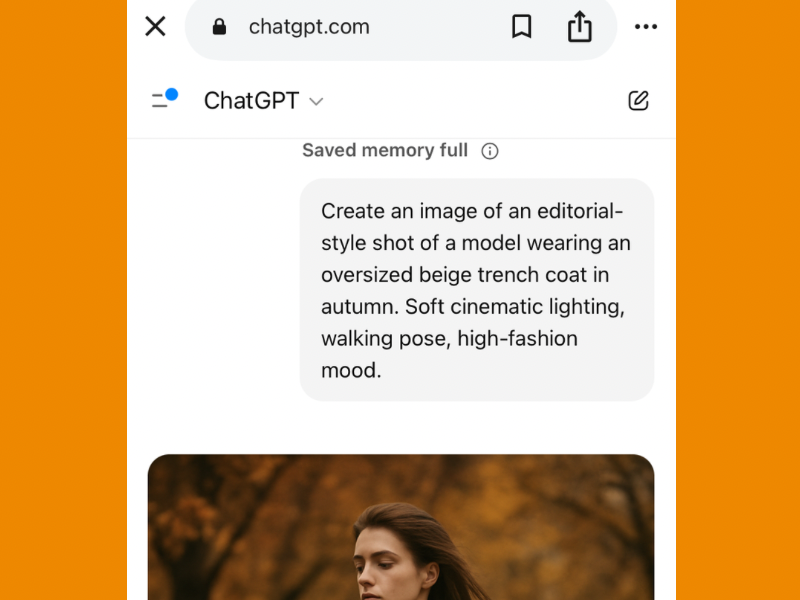
The image created using ChatGPT looked grounded and realistic.
It looked like what you would see in a catalogue or real-life product shoot. It was not as stylised as the one produced using Gemini, but it looks more practical and believable.
Also, the model’s pose screamed editorial, confident, and aspirational.
In short, ChatGPT is the “creative director” of AI image generation, which is brilliant for concept but not always precise for real-world application.

Gemini Nano Banana’s Result
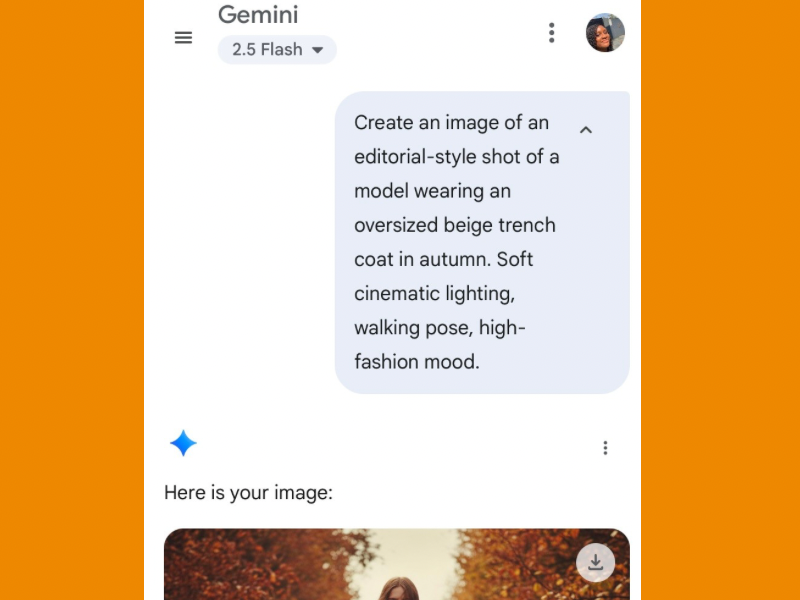
The image produced by Gemini Nano Banana was completely different.
It was more cinematic, stylish, and editorial.
The pose, the trench coat flow, and the colour palette.
It all looked like it was created for a magazine cover.

Also read: Is the Google Gemini Nano Banana AI Tool Safe?
What I learnt from This Experiment
When I placed the two images side by side, the difference was undeniable. Gemini’s output was dramatic, confident, and dripping with cinematic flair.
ChatGPT’s, on the other hand, looked like a Zara or H&M campaign shot due to the fact that it was simple, realistic, and immediately usable for a product catalogue.
Neither of the AI tools was universally better because they both excel in different contexts:
Google Gemini can be used for campaigns, social media storytelling, or mood boards. This is because it sells ideas and vision, not necessarily products.
On the other hand, ChatGPT can be used for product listings, catalogue images, or any scenario that requires realism. It sells trustworthiness and believability.
A Simple Workflow to Use
1. Create a powerful, concise prompt for your business needs.
2. Run it through ChatGPT first, and save the most visually appealing results.
3. Paste the same prompt into Gemini Nano Banana, and save the most realistic results.
4. Strategically combine results and ensure you utilize dramatic images for advertisements and realistic visuals for items.
5. Optional: touch up with Canva, Photoshop, or an AI upscaler.
It’s straightforward and reproducible and allows you creative freedom without wasting time or money.
So, next time someone asks, “Which AI tool is better?” Remember that it is not about better or worse, but it’s all about fit. Vision versus practicality and drama versus dependability. The moment you grasp this, you’ll be able to select the appropriate tool for the job every time.
Finally, here’s a pro tip: don’t just choose one AI tool but use both. Start with ChatGPT for vision and mood, then refine or complement with Gemini Nano Banana for practical assets.
If you’re curious about practical workflows and AI tools for startups, then you need to check out this article titled How to use AI tools for startups without breaking the bank