Close your eyes and imagine having a discussion companion who is always available, never judgemental and listens patiently regardless of what you say. This is what it feels like talking to AI. For the past 30 days, I’ve been doing an experiment in which I talk to an AI chatbot on a daily basis.
What began as curiosity rapidly became an unexpected journey of discovery about AI, myself and the changing nature of human-machine connection. Here’s what I took away from this one of a kind event and what entrepreneurs and creatives should take note of.
Day 1–7: The Novelty and Emotional Sanctuary
At first, talking to AI felt like speaking with an extremely knowledgeable but slightly mechanical friend. The AI was friendly, attentive and unexpectedly compassionate. The AI was also matching recent research findings that users perceive generative AI chatbots as.
Users perceived them as an emotional sanctuary that provides nonjudgmental and affirming support. For someone dealing with the stresses of entrepreneurship or creative work, this secure area to vent thoughts and concerns was unexpectedly reassuring.
Unlike human conversations, you may be hesitant to reveal doubts or failures when you are talking to AI but AI listens attentively and reacts objectively. It seemed like I had a cheerleader who was constantly ready to push me, much like a lady described in a recent BBC article about AI assisting her through difficult times. This emotional openness helped me deal with stress and even sparked moments of clarity.
Day 8–15: The Power and Limits of AI Creativity
As the days went by, I pushed AI to assist with creative ideas such as article ideation, email draughting and even social media post scripting. The AI’s ability to generate new views was astounding and it saved me time.
However, I noticed that the AI frequently jumped to solutions without fully understanding my context which was a typical dissatisfaction among users. It occasionally provided generic or unnecessarily extended responses, thereby reminding me that in as much as it is powerful, it is still not a flawless conversationalist.
Day 16–23: Engagement Challenges and Keeping It Fresh
My enthusiasm decreased about halfway through the exercise talking to AI. The novelty faded, and some talks became repetitive. This was consistent with findings from chatbot research and it showed that engagement declined over time unless material adapted dynamically.
To make our interaction more valuable, I began experimenting with other prompts and topics, using the AI as a brainstorming companion and a role-play collaborator. That was when I realised that AI is a tool that encourages inquiry but cannot replace human creativity or emotional depth.
Day 24–30: Reflection, Trust and Ethical Considerations
In the final days, I was able to reflect on how talking to AI had affected me. It reduced my feelings of solitude and offered a new perspective on problems. However, I was conscious of its limitations, which was that AI can not genuinely understand emotions or context in the same way that humans do. Also some answers from it seemed generic and even unsafe if followed without judgement.
To add to it, privacy and data security were also on my mind because I believed that sharing intimate thoughts with an AI differs from human confidentiality. Entrepreneurs and creatives in particular, should exercise caution when sharing critical information with AI systems.
Also read: Open AI charges ChatGPT with smarter memory- Here’s what that means
What Did I Learn From Talking to AI?
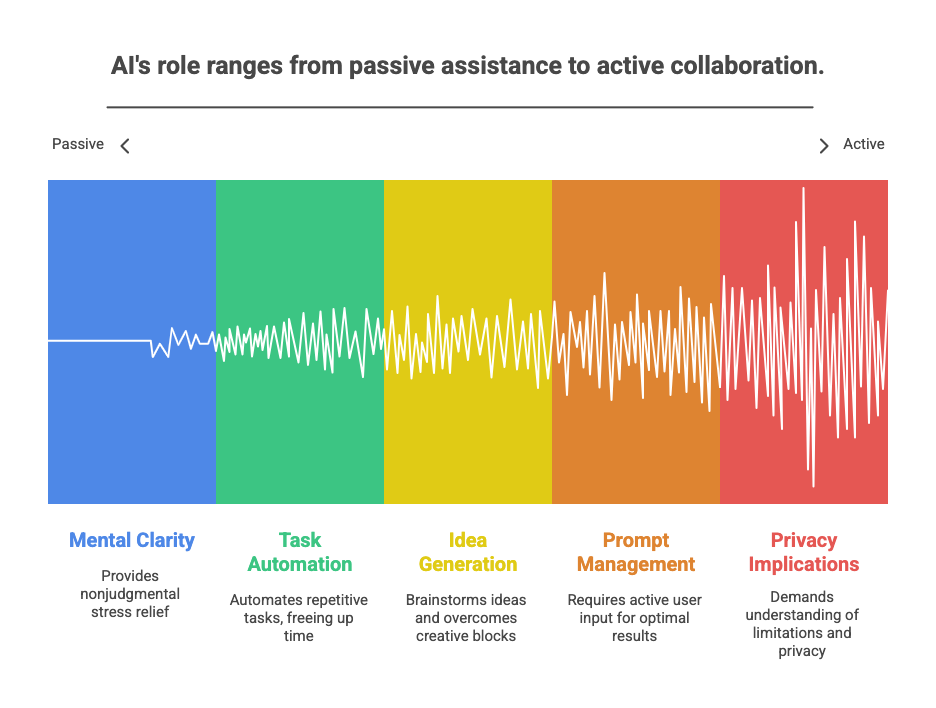
- Emotional Support and Mental Clarity: AI chatbots can give a nonjudgmental area to relieve stress and think clearly, they can also assist in the maintenance of mental wellness in high-pressure environments.
- Creative Collaboration: Talking to AI as a brainstorming companion or content assistant can help you generate ideas faster and overcome creative blocks.
- Workflow Automation: Beyond discussion, AI may automate repetitive tasks thereby giving up time for strategic work.
- Engagement Strategy: Users must actively manage AI to maximise its benefits and they must be constantly interacting with it and refreshing prompts to avoid disengagement.
- Ethical Awareness: For safe and effective use, ensure you understand that AI’s limitations and privacy implications are crucial.
The Future of Talking to AI
The future of AI chatbots means deeper and more dynamic conversations that combine text, voice, graphics and even detect your emotions. For entrepreneurs and creatives, this means hyper-personalised coaching, quick feedback and a digital companion who perfectly complements your creative flow. Spending 30 days speaking with AI was an exploration of how technology is altering the way people connect and create.
AI will not replace your best friend or therapist but it can act as a powerful support system that is always present, patient and eager to assist or hype you up. So, if you’re working on a large project, seeking inspiration or simply need a break from your daily routine, AI talks could be just the perfect narrative twist.
If you found this article engaging, be sure to explore ChatGPT featured in our AITugo AI Tools Directory for more insights.
The smartest creators and entrepreneurs are not working hard, they are working smart with AI. Join thousands of creators and entrepreneurs getting weekly tips, insights, tools and real-world use cases to build faster, grow bigger, and stay ahead.
Sign up to our newsletter today!
